Roider Lab Research
Translational Dermatology Program
The Roider Lab investigates how human skin maintains function, adapts to stress, repairs damage, and transitions into disease. We study skin as a dynamic metabolic, immune, and regenerative organ in which melanocytes, keratinocytes, fibroblasts, immune cells, and tumor cells exchange signals that shape resilience, pigmentation, aging, inflammation, and cancer risk.
Our research integrates full-thickness human skin explants, melanoma patient cohorts, mitochondrial redox biology, pigmentation science, single-cell and spatial transcriptomics, and experimentally controlled models of skin stress and disease progression. This human-relevant approach allows us to connect mechanistic discovery with clinically important questions in dermatology, oncology, inflammation, aging, and skin repair.
Explore Our Translational Research Framework
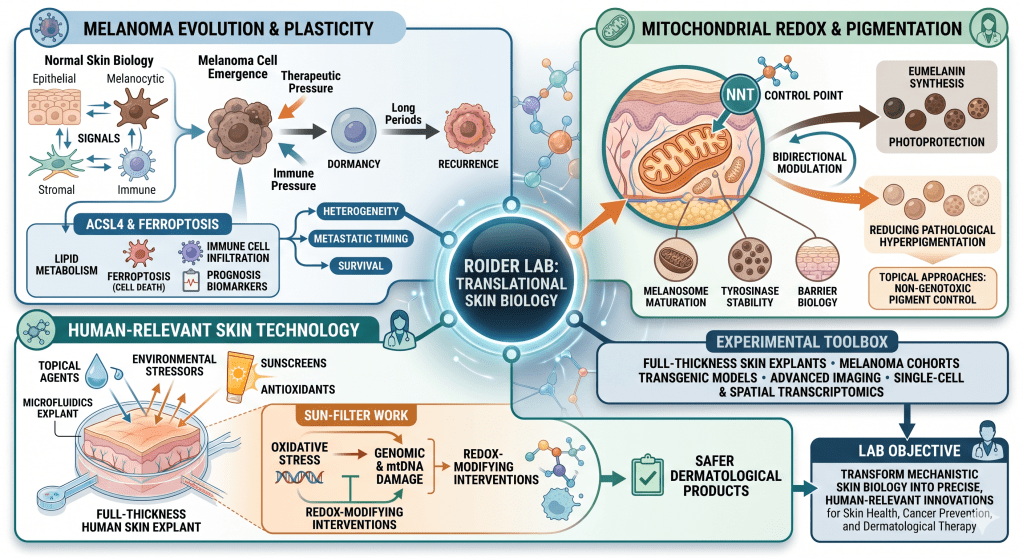
The lab investigates how human skin maintains function, adapts to stress, and transitions into disease. We study skin as a dynamic, metabolically active, and immune-competent organ, using physiologic human skin explants, melanoma models, spatial and single-cell technologies, and experimentally controlled models of skin stress and disease progression.
Our research connects melanoma development and plasticity, ferroptosis, pigmentation disorders, mitochondrial redox biology, aging, and tissue-level stress responses.
A central focus is the NNT pathway, through which we aim to control pigmentation by targeting mitochondrial redox biology rather than relying on UV exposure or non-specific chemical approaches. By integrating patient-relevant models with molecular precision, we identify pathways that govern melanoma delayed recurrence, pigmentary imbalance, oxidative damage, and skin resilience.
The lab brings together dermatology, cancer biology, metabolism, transcriptomics, clinical insight, and translational innovation. Our goal is to generate discoveries that are mechanistically deep, clinically relevant, and strong enough to inspire new strategies for prevention, diagnosis, and therapy.
Click to enlarge ▲

